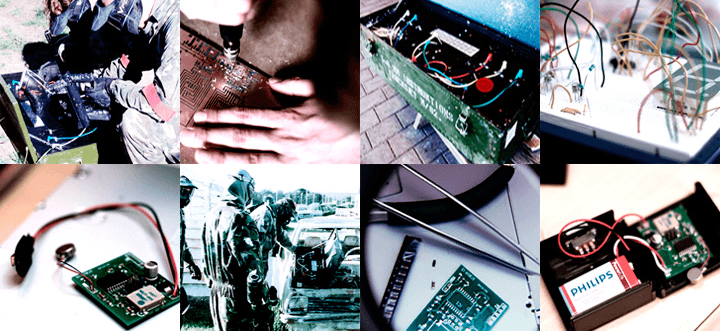
ACME Bomb #2
Undergraduate Thesis · Aarhus University
An undergraduate thesis studying how external stressors change behavior in already high-stress situations — a Counter-Strike bomb built for a professional paintball team through participatory design.
Overview
The second iteration became my undergraduate thesis: a study of what happens when you introduce external stressors into an already high-stress situation. We built a full Counter-Strike scenario for a professional paintball team — a bomb housed in a military surplus mortar box, with a large segmented display, a big red button, and heavy wires for disarming it.
Players wore armbands that beeped and vibrated — slowly at first, then faster and faster — while the bomb itself beeped loudly alongside them.
Participatory Design
We used participatory design, treating the players as co-designers. Across four site visits, they shaped the device directly:
- The wire cutters from the first bomb became large jack plugs — easier to handle with gloves and excess adrenaline.
- A larger display and a larger case.
- Press-and-hold the big red button for ten full seconds to complete the disarm — leaving you completely exposed.
- The beeping frequency and the armband vibration patterns came straight from the players.
The Result
These were pros — serious gear, serious skills. The adrenaline of getting hit with a machine gun of paintballs had worn off for most of them years ago. But with the bomb, they came alive again. They took more risks, they worked more as a team, and after the matches they were wild and giddy. They loved it.
Why It Matters
Hardware built from scratch, interactions designed on top of it, and then put into real people's hands to see how it actually changed their experience. Academic-grade hardware prototyping paired with rigorous field research.